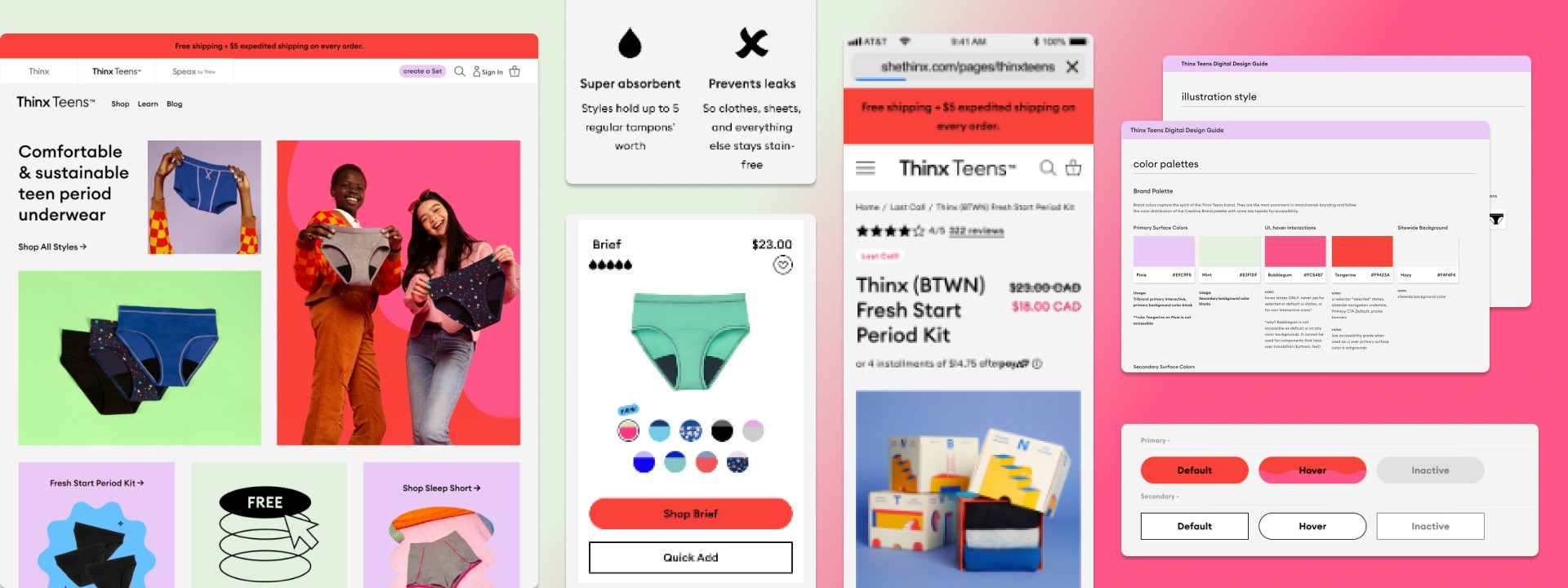
Shaping a period underwear experience for first-time users and their parents, simplifying sensitive content into clear, trust-building journeys that drive confident decisions.
UX Research
UX/UI Design
Design Systems
E-commerce
Product Domain
E-commerce, Responsive Web
Role
UX/UI Designer
Company
Thinx Inc.
Industry
Health & Wellness, Consumer Products
Impact
Achieved 5.52% conversion rate within two months of launch
Drove +27.1% revenue growth, the strongest performance across all three brands
Successfully designed for a dual-user experience (teen + parent) without compromising either audience
Increased cross-brand discovery through tri-brand navigation Thinx Teens → Thinx: 25.37%)
Established a scalable brand system layered on a shared design foundation
Overview
Thinx Teens was Thinx Inc.’s expansion into teen period care, designed for girls ages 10–16 navigating their first periods.
The product introduced a meaningful shift in the category: absorbent underwear that replaced pads and liners without requiring a teenager to learn how to use a tampon.
Designing the experience meant solving for a uniquely complex problem, a dual user with fundamentally different needs. The teen needed to feel confident, normal, and understood. The parent needed reassurance around safety, efficacy, and value.
I led the UX design of the Thinx Teens e-commerce experience as part of the broader Thinx Inc. redesign, which drove the strongest revenue performance across all three brands.
My Role
I was the UX designer responsible for UX architecture, interaction design, and responsive implementation across the Thinx Teens experience. I worked within a cross-functional team spanning research, visual design, and development, building on a shared component system with a distinct brand layer tailored to a younger audience. My team consisted of the UX research director (Alyssa Nasca), UX researcher (Elise Mortensen), visual designers (Kim Suchy and Genna Schwartz), creative director (Meng Shui), and a development team led by Brendan Hastings. The Thinx Teens design system was built on the same universal component foundation as Thinx and Speax, with a distinct brand token layer applied on top.
The full experience, including component architecture, responsive layouts, and the brand token layer, was designed and documented in Figma, built on the same shared library file used across Thinx and Speax.
The Problem
Designing for Thinx Teens required solving for a dual user with fundamentally different emotional and functional needs.
The teen needed to feel seen, not embarrassed. She was navigating an intimate, often anxiety-producing life transition in a product category that had historically made her feel clinical, awkward, or like she was being handed something her mother used. The experience needed to feel age-appropriate, fun, and empowering, not medicalized.
The parent, often the one making the actual purchase, had completely different concerns. Price justification. Efficacy. Washing instructions. Safety. Whether this product was appropriate for their daughter's body and activity level. The experience needed to answer all of those questions clearly without making the teen feel like the product was designed for adults who were worried about her.
Designing for both simultaneously, within a single experience, without alienating either, was the core UX challenge.
Key Insight
Our research included focus groups with girls ages 10-16 and their parents in Houston and New York City. One finding that kept surfacing reshaped how we thought about the product's positioning entirely.
In many households, especially in regions where cultural and religious values placed significance on a young girl's physical development, parents were actively reluctant to introduce tampons. Teaching a daughter to use a tampon was fraught with anxiety for families who connected internal period products with questions of virginity and bodily autonomy. It was a conversation many parents wanted to avoid entirely.
Thinx Teens offered a way out of that conversation. Absorbent underwear that worked without insertion, that felt like normal underwear, that a teenager could put on and go to school in without needing instruction or assistance. For many parents, that wasn't just a product benefit. It was a relief.
This insight informed the entire content and communication strategy. We didn't lead with the technical product story. We led with comfort, normalcy, and confidence. The product education was there for the parents who needed reassurance. The tone and visual language were there for the teen who needed to feel like this was just underwear, not a medical device or a compromise.
Key Design Decisions
Decision 1: Tone as a design element.
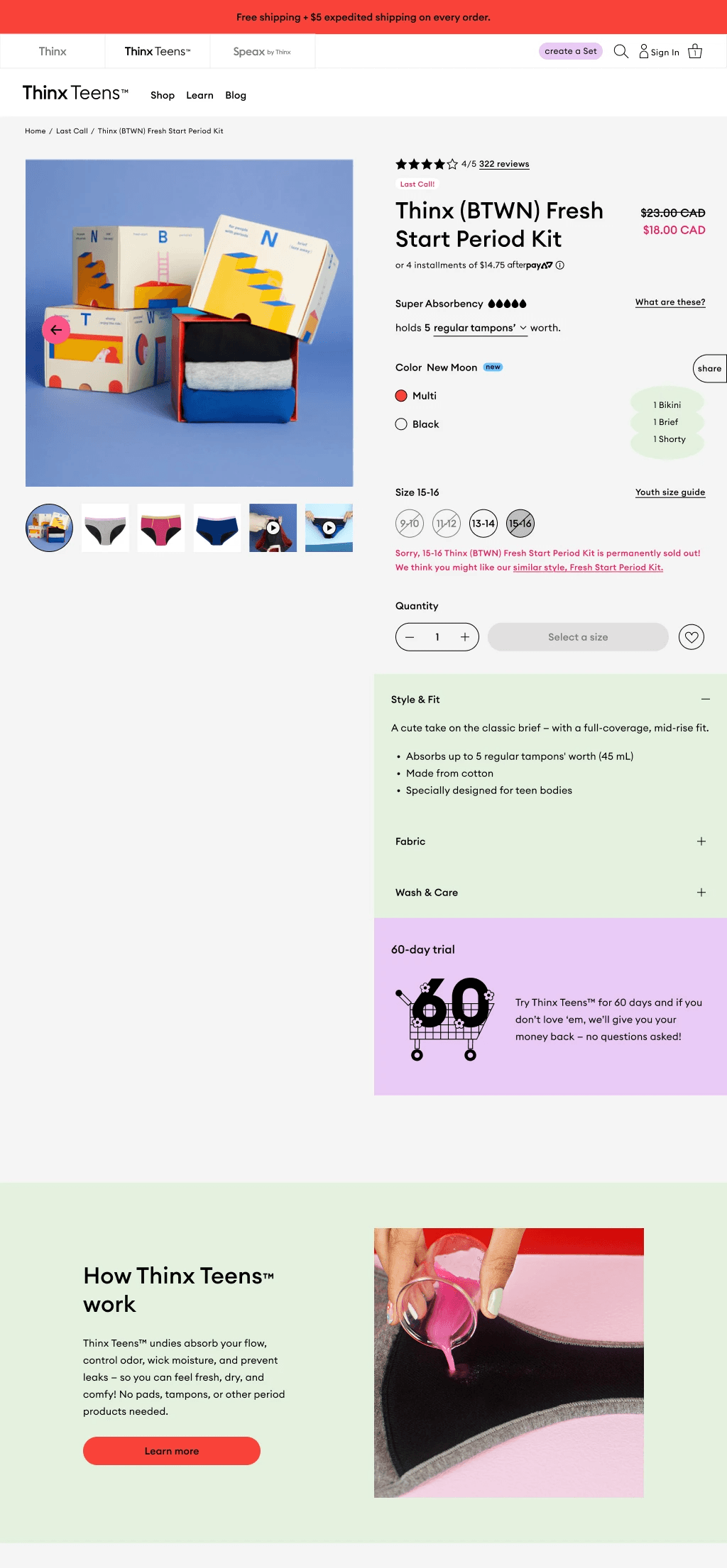
Thinx Teens's visual and tonal direction was deliberately distinct from both Thinx and Speax. Thinx was activist and adult, bold photography, political positioning, direct language. Speax was mature and reassuring, designed for women navigating a stigmatized health condition with dignity. Thinx Teens needed to be neither of those things. The tone was lighthearted, warm, and supportive. Not childish, not clinical. The visual language leaned into fun patterns, bright colors, and age-appropriate lifestyle imagery that showed teenagers doing normal teenage things. Adults kept asking if Thinx Teens came in adult sizes. That was the right outcome.
Decision 2: Content hierarchy designed for two readers.
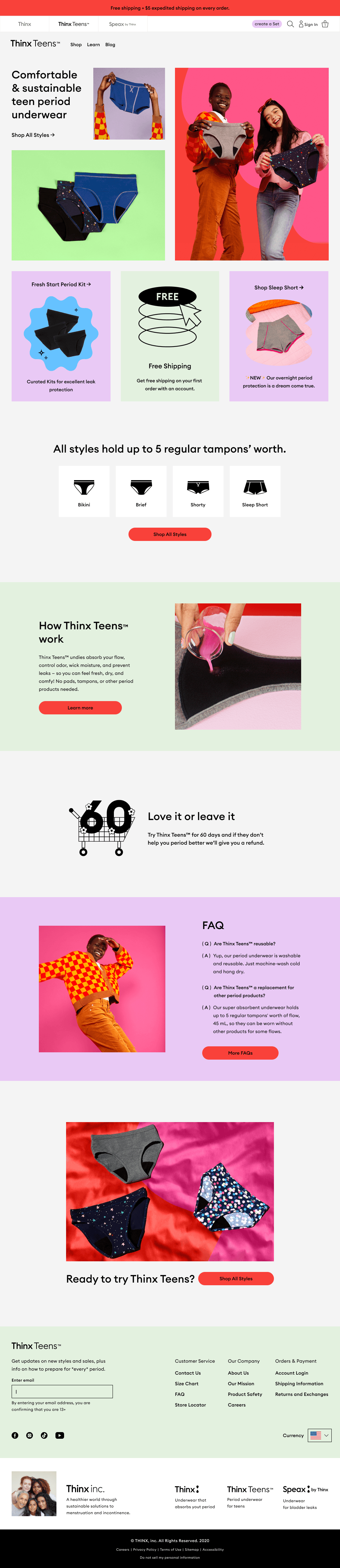
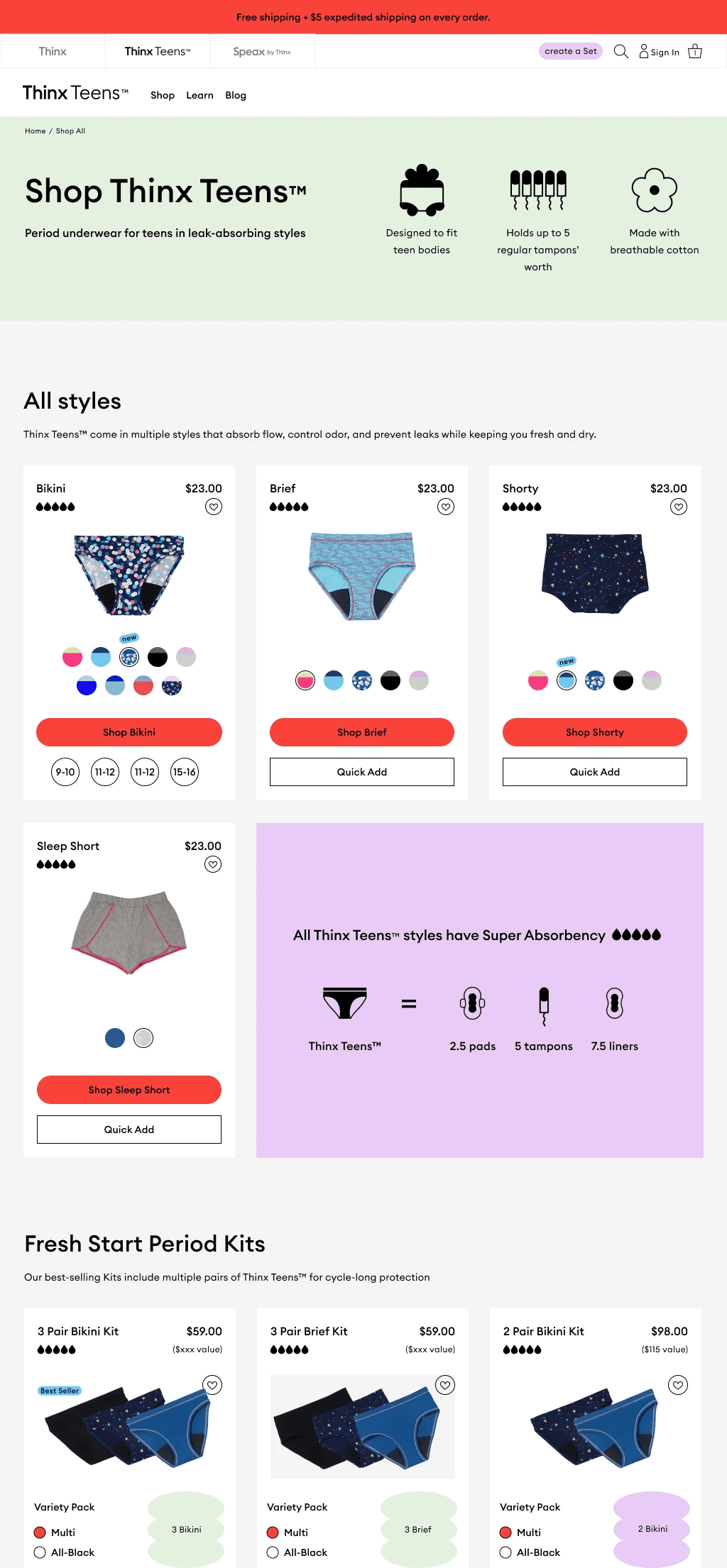
Every page had to work for a teenager browsing on her phone and a parent doing due diligence before adding to cart. I structured the page hierarchy so the emotional and aspirational content came first, the teen's entry point, and the practical information, absorbency, care instructions, sizing, return policy, was accessible but not dominant. The parent could find everything they needed. The teen didn't have to wade through it to feel like this product was for her.
Decision 3: Educational content that normalized the conversation.
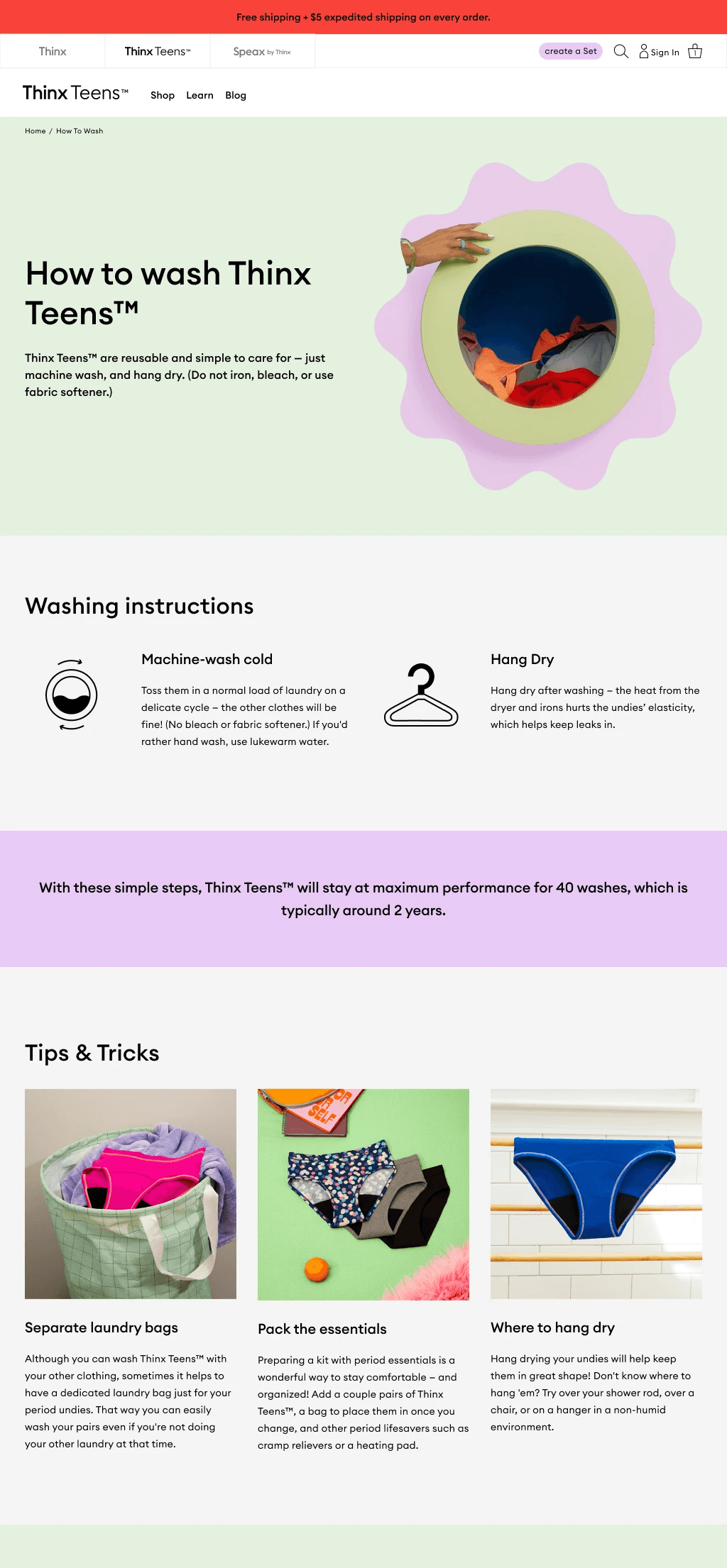
Thinx Teens included a blog and educational content section that answered period questions in accessible, non-clinical language. This served both audiences simultaneously. For teens it was a resource that made periods feel less scary. For parents it was evidence that the brand understood their daughter's experience and could be trusted. The content strategy was part of the design system, not an afterthought, integrated into the site architecture as a first-class section rather than buried in an FAQ.
Designing for Dual Users
The central design challenge was building a single experience that respected two fundamentally different users without splitting the site in two. A teen landing on the product page needed to feel understood. A parent landing on the same page needed to verify safety, fit, washing instructions, and value before spending on a product she had never bought before. Either audience treated as the primary one would push the other away.
The resolution was sequencing, not segmentation. Every touchpoint was designed to answer the teen's emotional question first and the parent's practical question next, inside the same frame. Lifestyle photography and playful copy opened the product story in a register that made the teen feel the brand understood her. The product information that followed, covering absorbency, materials, washing, and sizing, was written in plain language so the parent could verify the answers without hunting through a separate support page. Educational content about periods was integrated directly into the main site architecture rather than buried in an FAQ, which made it legible to both audiences as a shared resource.
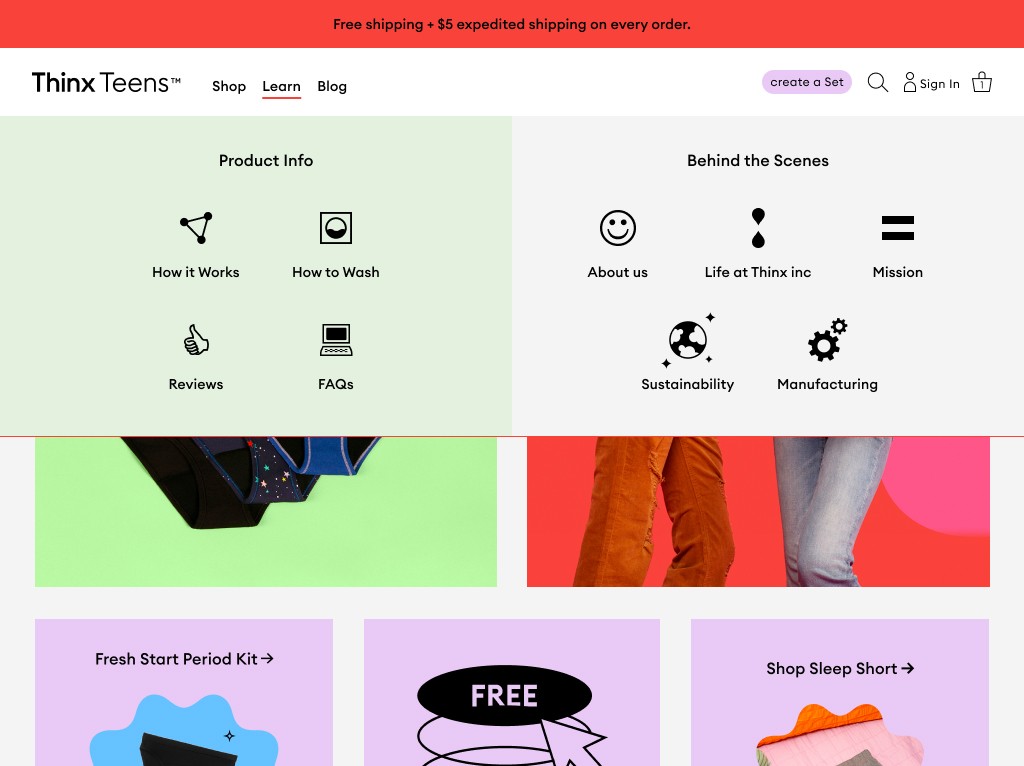
Navigation followed the same logic. The main menu led with the categories a teen would use to shop. The resources a parent needed to feel confident about the purchase were one layer below but always within reach, never gated or siloed.
The result was a single experience that felt age-appropriate to the person wearing the product and trustworthy to the person paying for it. That shared trust is what made the tri-brand navigation work and the 25.37% cross-brand discovery rate possible.
The Brand Layer
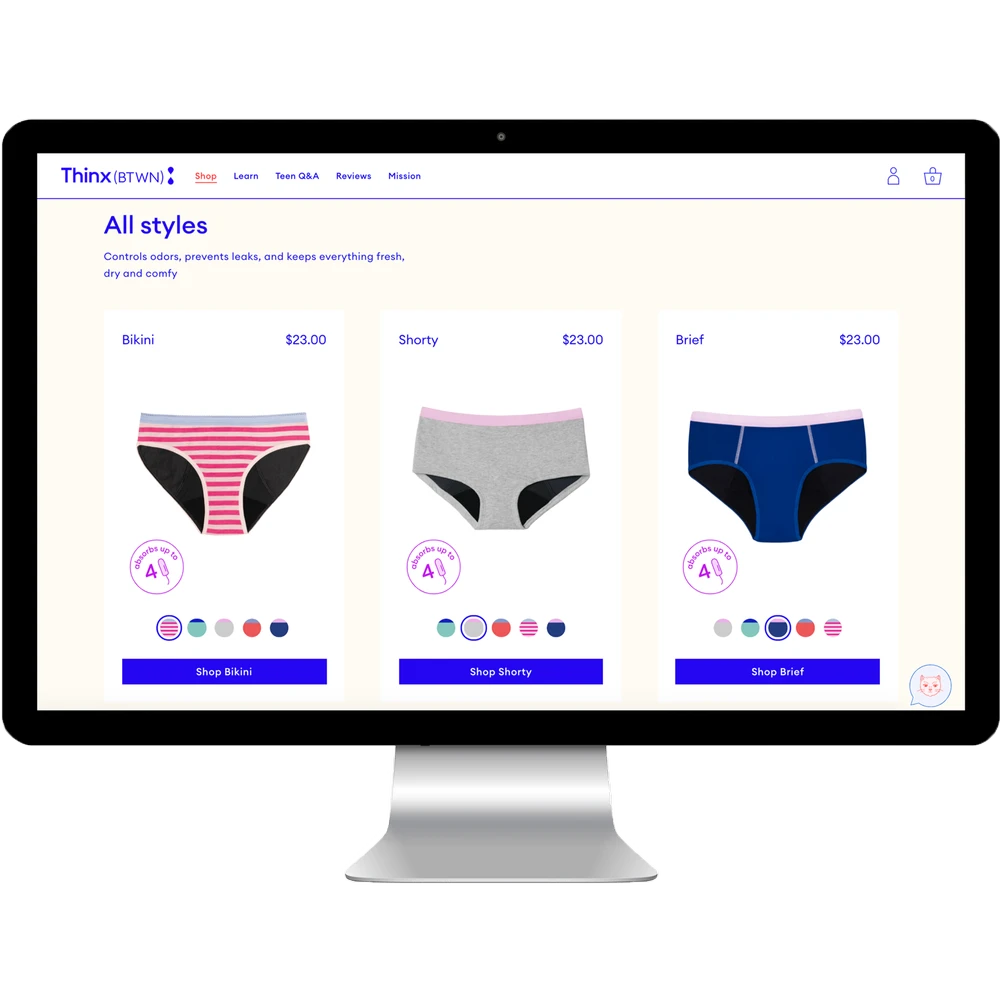
Within the universal Thinx Inc. design system, Thinx Teens had its own distinct token layer. Color palette shifted to softer, more playful tones. Typography felt lighter and more approachable than the Thinx main brand. Iconography and illustration style were age-appropriate without being juvenile. Patterns and limited edition colorways became a genuine differentiator, generating interest from adult Thinx customers who discovered Thinx Teens through the tri-brand navigation and wanted the same aesthetic.
That crossover traffic was evidence that the brand token layer had done its job. Thinx Teens felt distinct enough to attract its own audience while living coherently within the Thinx Inc. family.
In practice this meant overriding the color, typography, and iconography tokens in the brand-specific layer while leaving the universal component structure, spacing system, and interaction logic untouched, the same product card, navigation, and PDP components used across Thinx and Speax, with a completely different visual expression on top.


Impact
Conversion rate: 5.52%
Revenue increase: +27.1% (highest across all three brands)
Cross-brand traffic:
Thinx Teens → Thinx: 25.37%
Thinx Teens → Speax: 7.94%
Reflection
This was the most emotionally complex design problem I’ve worked on. Most ecommerce UX is about reducing friction on the path to purchase. Thinx Teens required thinking about the emotional state of a 13-year-old who might be embarrassed to even be on this website, and the parent who might be relieved she doesn't have to explain something she's been avoiding.
The thing I'm most proud of is that the brand didn't talk down to teenagers. A lot of "designed for teens" products feel like adults trying to seem relatable. Thinx Teens felt like it was genuinely made for them. The patterns were cool. The language was honest. The experience treated young people as capable of understanding their own bodies. That was a deliberate design choice at every level, from the visual system to the content hierarchy to the tone of every label and button.
Getting that right required listening to the research, trusting what teenagers actually said in the focus groups rather than what adults assumed they wanted, and making design decisions that served the user first.